
Troy McDonald Reports from the United Nations Permanent Forum on Indigenous Issues
4 May 2026
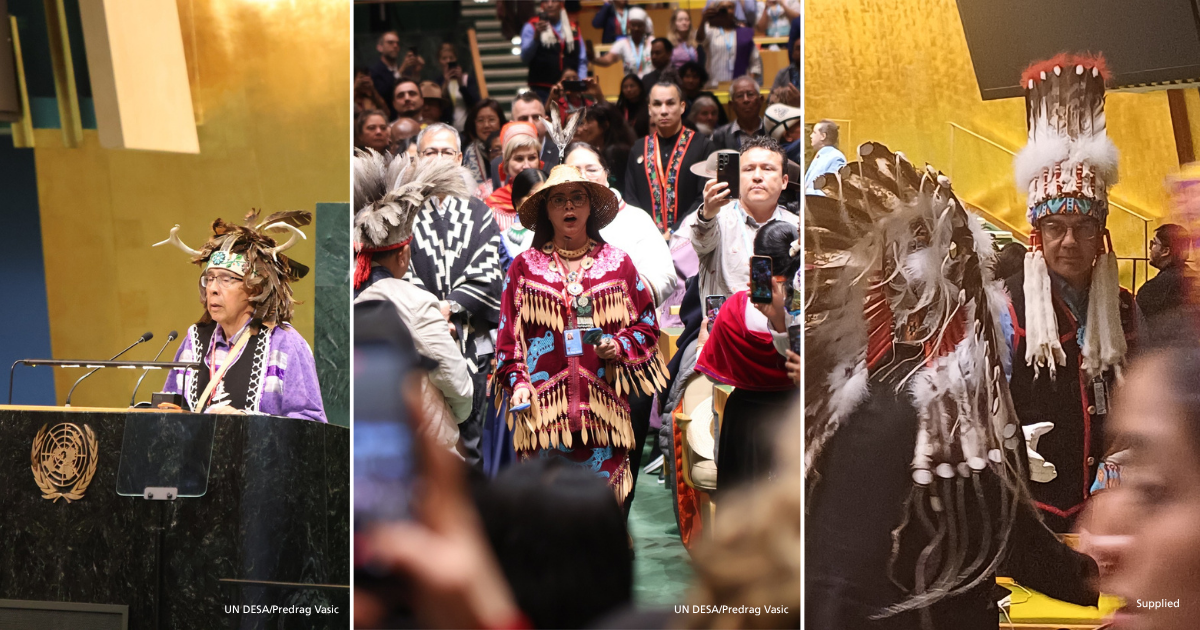
Last month Troy McDonald, GLaWAC’s Reserved Seat Member on the First Peoples’ Assembly of Victoria and the Chair of GLaWAC’s Board of Directors, travelled to the United States for the 25th session of the United Nations Permanent Forum on Indigenous Issues (UNPFII).
The forum was held at the United Nations Headquarters in New York.
Here is Troy’s report from that event.
Dear Gunaikurnai allies, friends, members and community.
A notable emerging focus at the 25th session of the UNPFII were stronger calls for binding accountability mechanisms to ensure states uphold Indigenous rights beyond voluntary commitments.
The key themes emerging from the UNPFII were consistent across a broad landscape: the impacts of war, deforestation, habitat destruction, and aggressive mineral extraction.
These issues strongly align with Australia’s context in relation to First Peoples.
Michael Oregana, special rapporteur on toxins and contamination, emphasised that health systems fail when they are not inclusive, calling for a shift from symbolic gestures to structural change.
He highlighted that cultural neglect undermines relationships with service systems and argued that “100% care” complements Western models of health.
There was a strong view that disparities could be reduced by embedding cultural practice as a standard element of healthcare globally.
Intercultural models – as guardians of life – supported by sustainable investment, were identified as pathways forward.
These should be grounded in participatory co-design and informed by the principle that “peace is the presence of justice” (Oregana, 21 April 2026).
Brian Stevens [GLaWAC Board Director], Peter Hood [First Peoples’ Assembly of Victoria Representative] and I presented at two events, focusing on Treaty outcomes and the role of the ACCO sector.
A key message was: “We weren’t just asking for Treaty – we were designing how Treaty would actually work.”
Truth-telling was positioned as a parallel and equal process, essential to shaping the architecture and development of the draft Treaty bill.
As stated, “Truth is not a side conversation – it is the foundation for justice and legitimacy.”
Insights from North and Central America highlighted the ongoing crisis of murdered and missing Indigenous women and girls.
This remains a global issue, often inadequately addressed by authorities, though advocacy efforts continue to push for accountability.
Access to clean, safe water was another critical concern.
The poisoning of waterways – linked to unregulated and corporate-driven extractive industries – continues to impact cultural practices, including medicine and food harvesting.
These challenges were particularly emphasised by First Peoples from South America, North America, and the Arctic.
The presence of nation states such as China and Russia often resulted in state perspectives being prioritised over Indigenous voices.
There was a strong perception that state-sponsored narratives, including those relating to regions such as Tibet, shaped counter-positions at the forum.
A significant concern raised was the safety of Indigenous representatives.
There is a documented fear that some past participants have disappeared after speaking at such forums, contributing to ongoing caution and the complex dynamics of state participation.
Caribbean community perspectives highlighted barriers to healthcare access, alongside the intersecting impacts of conflict, climate change, and geopolitical pressures.
Summary
The 2026 UNPFII reinforced that Indigenous rights, health equity, environmental protection, and justice are inseparable.
From Australia to the Americas and the Arctic, the same structural inequities persist, demanding not acknowledgment but implementation.
Moving forward, the priority must be embedding intercultural governance, protecting water and land, and ensuring truth-telling informs policy at every level.
Without enforceable commitments from states, these dialogues risk repetition rather than reform.