Native Title
On 22 October 2010, the Federal Court recognised that the Gunaikurnai people hold native title over much of Gippsland.
What is Native Title?
Native title is the recognition in Australian law that some Indigenous people continue to hold rights to their lands and waters that come from their traditional laws and customs.
Native title has its source in the laws and customs observed by Indigenous people when Australia was colonised by Europeans. Those laws and customs must have been acknowledged and observed in a ‘substantially uninterrupted’ way from the time of settlement until now.
Native Title:
• is administered through the Commonwealth Native Title Act 1993.
• is not granted by governments but recognised through a determination made by the Federal Court.
• will vary for each group because it comes from traditional laws and customs of the group.
• exists alongside and is subject to, the rights of other people in the same area.
• can be extinguished because of things the government has done, or allowed others to do, over a particular area that are inconsistent with native title.
What is the Native Title Act?
The Native Title Act 1993 is a Commonwealth law that provides a process by which Indigenous Australians can lodge applications in the Federal Court of Australia seeking a determination of native title.The Native Title Act 1993 also provides a process for applicants and native title holders to negotiate and enter into agreements relating to actions that affect native title interests. These actions are known as future acts.
How do you get Native Title?
The Court does not ‘give’ native title, rather it recognises that it still exists.
You have to prove:
• that you possess rights and interests to the land under traditional laws and customs.
• that those laws and customs are currently acknowledged and observed, in a continuous connection going back to pre-colonisation.
• Native Title has not be extinguished.
What does recognition of Native Title give you?
Native Title does not give you ownership, but provides the right to camp, hunt, fish, gather food, and teach law and custom; and the right to negotiate with anyone seeking to carry out activities that might affect your rights.
Consultation and consent under the Native Title (Prescribed Body Corporate) Regulations 1999
As a prescribed body corporate, GLaWAC is empowered to make native title decisions and negotiate agreements on behalf of the Gunaikurnai native title holders. The Board does so in accordance with the GLaWAC Delegations Policy and with the support and on the recommendation of the Native Title and Cultural Heritage Subcommittee.
In addition, and in accordance with the Native Title (Prescribed Bodies Corporate) Regulations 1999 (PBC Regulations), the Board must undertake a process of consultation and consent with native title holders as part of that agreement-making process.
The process for consulting with native title holders and deciding whether consent has been received was agreed at a Gunaikurnai native title meeting on 30 November 2012 and incorporated into the GLaWAC Rule Book (see Rule 8). Once an agreement has been negotiated, the terms of the agreement and supporting information will be provided to both member and non-member native title holders and made available on the GLaWAC website as part of the consultation and consent process. Comments and feedback will be invited within 4 weeks of the mail-out date.
Following the consultation and consent process, Rule 8.1 provides that GLaWAC Directors will agree by majority vote whether the consultation and consent requirements for a particular native title decision have been met. Standing authorisations for future act notifications inviting comment The common law holders have also been consulted and have previously consented to the Board making decisions about whether to comment and whether to oppose, agree to or seek conditions in relation to certain future acts notifications inviting comment (see Rule 8.2).
Crown Land Sales
The Victorian Government occasionally sells surplus crown land, including land that is subject to native title. The sale of crown land will extinguish native title. There is no explicit right of veto, however, the State of Victoria does not currently compulsorily acquire native title-determined land, which means if agreement is not reached the sale will not proceed. (Note: the State’s position could change). This activity requires GLaWAC to “consult with and obtain the consent of native title holders” and compensation for the sale of crown land is usually negotiated.
Exploration Licence Applications
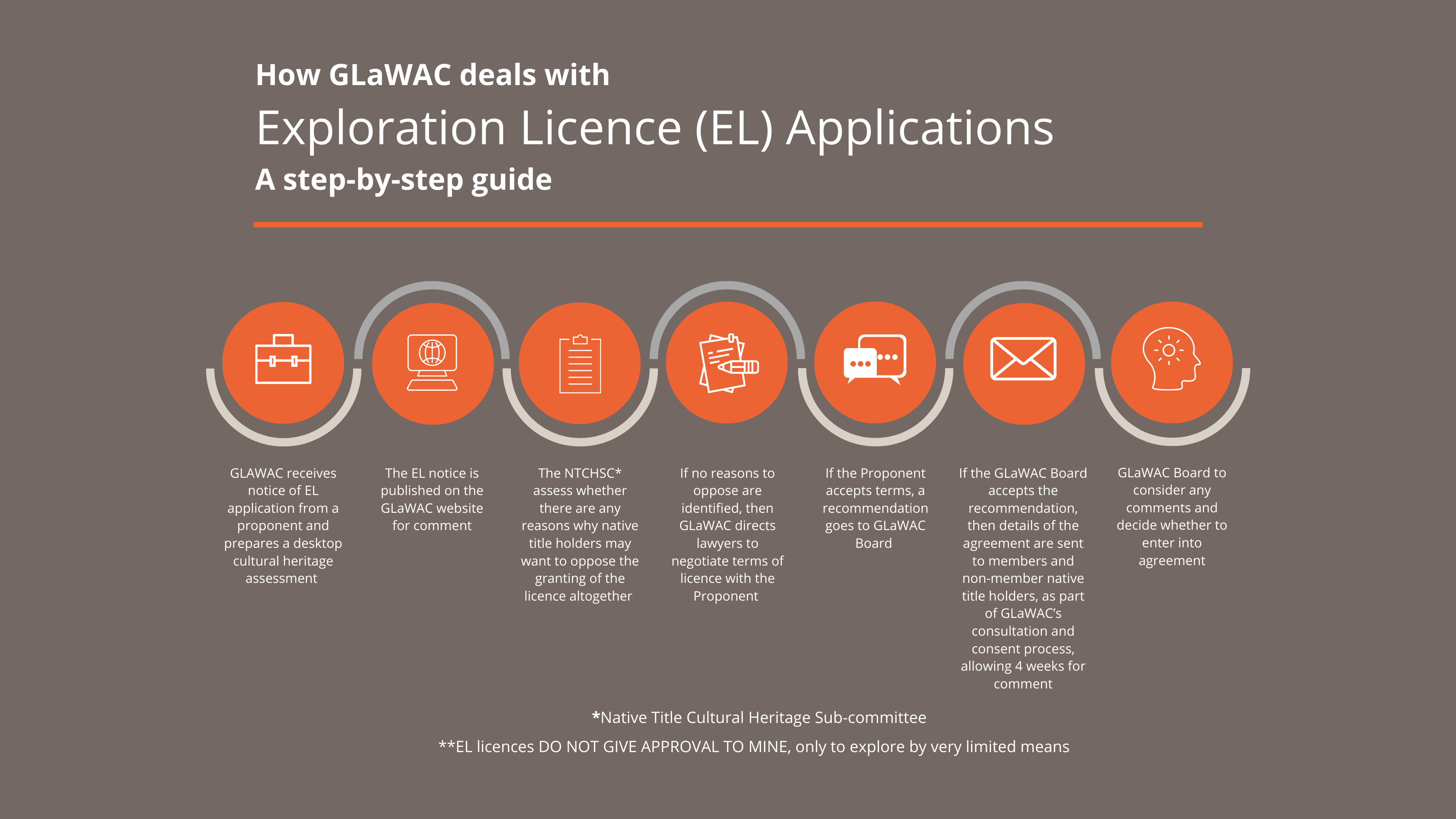
GLaWAC receives numerous exploration licence applications every year for exploration on Gunaikurnai native title-determined land. Under the Native Title Act, GLaWAC has a right to negotiate agreement terms with a Proponent, but does not have the right to stop the exploration.
A cultural heritage desktop assessment is made on each application, which is in turn reviewed by the Native Title and Cultural Heritage Sub-Committee (NTCHSC). The NTCHSC then makes a recommendation to the GLaWAC Board. If the Board accepts the recommendation, and the Board and the Proponent have agreed on the terms, all details to be made available on the website and mailed out to members with 4 weeks for response. First Nations will mail details to non-member native title holders on its mailing list. If any responses are received, these will be reviewed by the Board who will then decide whether to proceed with the agreement.
All Other Notices Concerning Works On Native Title Lands
There are various activities on native title lands which will trigger different future act processes. Depending on the activity, native title holders have the following procedural rights:
1. The right to be notified
2. The opportunity to comment
3. The right to be consulted
4. The right to negotiate over particular aspects of the future act
5. The right to object to the future act
Gunaikurnai RAP Boundary Position Statement
The Gunaikurnai respect due process in all matters linked to the Native Title Act, the Traditional Owner Settlement Act, and the Registered Aboriginal Party process.
The Gunaikurnai Land and Waters Aboriginal Corporation (GLaWAC) represents the families of the five clan groups of the Gunaikurnai, which cover a large part of Gippsland.
Most of the Gunaikurnai clan areas have been resolved under current formal agreements. Some are still outstanding areas. The Gunaikurnai will progress these matters when our families and right people for Country deems appropriate.
The Gunaikurnai are aware of various actions happening by neighbouring groups to determine the right people to speak for Country. GLaWAC is prepared to work in a respectful and collaborative manner, through the right people for Country, to determine these matters.
The Gunaikurnai will continue to assert their rights and interests over our traditional lands, while understanding the difficulty created by the historical dispossession of traditional lands.
If groups wish to pursue their own process that the Gunaikurnai feel undermine our rights and interests, GLaWAC will respond to protect the unfinished business of the Gunaikurnai.
Until formal applications go through the established processes, the Gunaikurnai do not support any claims, maps or materials generated by neighbouring groups, only their rights to progress these conversations.
The Gunaikurnai will work respectfully and collaboratively with our neighbouring mobs to clarify who the right people to speak for Country are under the rules of the Native Title Act, the Traditional Owners Settlement Act and/or the Registered Aboriginal Party registration process.
The Gunaikurnai also note and respect that there are future Treaty opportunities for all.
Wilsons Promontory (Yiruk) Native Title Claim
The Gunaikurnai people lodged a native title determination application in the Federal Court on 9 December 2014 under the Native Title Act 1993 (Cth). The application included the land and waters west of the Gunaikurnai determination area to the Tarwin West River, including Wilsons Promontory and Cape Liptrap (the claim area).
In September 2019, the Gunaikurnai decided to withdraw from the current claim that was to be heard in the Federal Court in order to focus on discussion and mediation with Bunurong- Boon Wurrung communities to realise a joint vision and aspirations for Wilsons Promontory.
The determination application for Wilsons Promontory is a complex and ongoing matter, and GLaWAC will continue to work with other Traditional Owners to reach an agreement for this area of land.
Key Messages
– The Gunaikurnai hold strong connections to Yiruk (Wilsons Promontory) and have a long history of association with and caring for country.
– The Gunaikurnai name for this area, Yiruk, means rocky place. The Gunaikurnai spiritual deities, Loohern and Loohern Tula, roamed the mountains and valleys in Yiruk and we pay our respects to the deities.
– The Gunaikurnai will continue to assert their rights and interests over this area.
– The Gunaikurnai decided to withdraw the current claim in order to focus on discussion and mediation to realise a joint vision and aspirations for Wilsons Prom.
– The Gunaikurnai do not accept the findings of the second conference of experts.
– These findings have not been tested in court.
– The claim was discontinued with no adjudication as to its merits.
– This does not prevent a future claim being made by the Gunaikurnai over Wilsons Prom.
Current Notices
GLaWAC will put up all notices concerning works on native title lands for native title holders to make comment if they wish. We will highlight where activities extinguish native title rights, although this is rarely the case. Please see below current notices on land:
—————–
RE: NOTICE CONCERNING WORKS ON NATIVE TITLE LANDS (RIGHT TO COMMENT)
BRIDGE CONSTRUCTION – WONNANGATTA RIVER, EAGLEVALE, ALPINE NATIONAL PARK
Parks Victoria is proposing to construct a pedestrian bridge over the Wonnangatta River at Eaglevale, in the Alpine National Park.
Replacement of the bridge destroyed in January 2026 bushfires.
Works include construction of a metal pedestrian bridge within the similar footprint as the destroyed bridge.
Your comments on how this proposal might affect your other native title rights and interests, and how that can be managed or addressed as part of this approvals process are also keenly sought.
Please note that the ‘non-extinguishment’ principle applies to these works and your native title rights will continue to exist over the site.
Should you wish to discuss this proposal please contact:
Sharna Foon – Parks Victoria
Email: sharna.foon@parks.vic.gov.au
The deadline for comments is Monday, November 9.
—————–
NOTICE CONCERNING WORKS ON NATIVE TITLE LANDS (RIGHT TO COMMENTS/SUBMISSIONS) PROPOSED TOILET AND CHANGE FACILITY AT ROSEDALE RECREATION RESERVE No.2 OVAL – END OF DUKE STREET, ROSEDALE
It is proposed by Rosedale-Kilmany Cricket Club, in partnership with Rosedale Recreation Reserve Inc, to install a public toilet and changeroom facility, and associated septic system, at the second oval of the Rosedale Recreation Reserve.
There’s more information about this proposal here.
The ‘non-extinguishment’ principle applies to these works and Native Title
rights will continue to exist over the site.
If you have questions or comments about this proposal please contact:
Will Hoban – DEECA Regional Office
william.hoban@deeca.vic.gov.au.
The period for comment ends on 28 October 2026.
—————–
RE: NOTICE CONCERNING WORKS ON NATIVE TITLE LANDS, PROPOSED WATER MAIN REALIGNMENT AT BOGGY CREEK – NOWA NOWA
East Gippsland Water proposes to realign the water main pipeline at Boggy Creek in Nowa Nowa which requires removing the existing pipeline and realigning it with a new pipeline.
The existing pipeline is coated with asbestos lagging and has ongoing safety, operational, environmental, and asset management risks.
Construction will be via open trench excavation within the former railway reserve corridor, and all disturbed areas will be reinstated post completion. The footprint of the proposed works will have minimal environmental impact including native vegetation disturbance.
There is additional information about the proposal in these attachments.
Attachment 1
Attachment 2
Attachment 3
All future acts are occurring on lands either permanently or temporarily reserved for public purposes.
The non-extinguishment principle applies to this future act.
Comments about this proposal should be sent to:
Maddy Arbuthnot
Program Support Officer
DEECA Traralgon
e-mail: maddy.arbuthnot@deeca.vic.gov.au.
The deadline to submit a comment is 12 October 2026.
—————–